Friss tételek

Book

A book is a set or collection of written, printed, illustrated, or blank sheets, made of paper, parchment, or other various material, usually fastened together to hinge at one side. A single sheet within a book is called a leaf, and each side of a leaf is called a page. A book produced in electronic format is known as an electronic book (e-book).

Books may also refer to a literature work, or a main division of such a work. In library and information science, a book is called a monograph, to distinguish it from serial periodicals such as magazines, journals or newspapers. The body of all written works including books is literature. In novels, a book may be divided into several large sections, also called books (Book 1, Book 2, Book 3, etc). A lover of books is usually referred to as a bibliophile, a bibliophilist, or a philobiblist, or, more informally, a bookworm.

A store where books are bought and sold is a bookstore or bookshop. Books can also be borrowed from libraries.

Etymology

The word book comes from Old English "boc" which comes from Germanic root "*bok-", cognate to beech. Similarly, in Slavic languages (e.g. Russian and Bulgarian "?????" (bukva)—"letter") is cognate to "beech". It is thus conjectured that the earliest Indo-European writings may have been carved on beech wood. Similarly, the Latin word codex, meaning a book in the modern sense (bound and with separate leaves), originally meant "block of wood."

Book structure

   1. Belly band
   2. Flap
   3. Endpaper
   4. Book cover
   5. Top edge
   6. Fore edge
   7. Tail edge
   8. Right page, recto
   9. Left page, verso
  10. Gutter

The common structural parts of a book include:

    * Front cover: hardbound or softcover (paperback); the spine is the binding that joins the front and rear covers where the pages hinge.
    * Front endpaper
    * Flyleaf: The blank leaf or leaves following the front free endpaper.
    * Front matter
          o Frontispiece
          o Title page
          o Copyright page: typically verso of title page: shows copyright owner/date, credits, edition/printing, cataloguing details
          o Table of contents
          o List of figures
          o List of tables
          o Dedication
          o Acknowledgments
          o Foreword
          o Preface
          o Introduction

Binding of a book from separate papers

    * Body: the text or contents, the pages often collected or folded into signatures; the pages are usually numbered sequentially, and often divided into chapters.
    * Back matter
          o Appendix
          o Glossary
          o Index
          o Notes
          o Bibliography
          o Colophon
    * Flyleaf: The blank leaf or leaves (if any) preceding the back free endpaper.
    * Rear endpaper
    * Rear cover

A thin marker, commonly made of paper or card, used to keep one's place in a book is a bookmark. Bookmarks were used throughout the medieval period, consisting usually of a small parchment strip attached to the edge of folio (or a piece of cord attached to headband). Bookmarks in the eighteenth and nineteenth centuries were narrow silk ribbons bound into the book and become widespread in the 1850s. They were usually made from silk, embroidered fabrics or leather. Not until the 1880s did paper and other materials become more common.

The process of physically assembling a book from a number of folded or unfolded sheets of paper is bookbinding.

Hungary Food & Dining

Hungary Food & Dining
A good range of restaurants is available, from inexpensive self-service establishments to fine dining eateries. Patisseries (cukrászda), serving cakes and pastries, and coffee shops (kavenas) are also popular. Gerbeaud’s is Budapest’s most famous coffee-house.

Things to know: There are no licensing hours. Minors are allowed to go into bars but will not be served alcohol.

National specialties:
Hungary Food & DiningHalászlé (a spicy soup made with freshwater fish and paprika).
• Gulyás (Hungarian goulash
is a hearty beef, capsicum and paprika soup; Western goulash is called pörkölt or tokány).
Gundel palacsinta (pancake served with walnuts, raisins, lemon rind, chocolate sauce and rum).
Paprikás csirke (paprika chicken).
Kolbasz (sausage spiced with paprika).

National drinks:
• Tokaji (strong dessert wine).
• Bull’s Blood (strong red wine).
Pálinka (brandy) comes in barrack (apricot), szliva (plum) or cseresznye (cherry) flavor.
• Beer.
Unicum (herb liqueur).

Legal drinking age: 18.

Tipping: 10 to 15% is expected in restaurants, bars, clubs, taxis and so on. Don’t leave the money on the table; tell the waiter or waitress the amount you wish to pay, including the tip.


Nightlife

Hungary Food & DiningBudapest is the country’s main nightlife center with myriad clubs, bars, discos and casinos. It is also home to the magnificent Budapest Opera House , which stages regular performances. Although on a smaller scale, the nightlife in larger cities and towns like Debrecen and Szeged is also lively and during the summer months the popular Lake Balaton resort of Siófok has a buzzing nightlife. Cinemas in major towns show many films in their original language with Hungarian subtitles. Western Hungary in particular has a lot of very good wine cellars that open late.

About Me and My Family (Én és a családom)


Me
About Me and My Family (Én és a családom)My name is Timothy. I live at home in Yorba Linda. I read books while I go to the bathroom. I look out the window and see pine trees. Once I saw a hawk at the top of the pine tree. I sleep in a bed in my sister’s room. Right now, my bed is on the floor. I like it. I eat at a table. My table is tan and made out of wood and screws. I toast bread. My favorite toast is made with butter, sugar, and cinnamon. I love it and I don't get it very often. I have $12.00. I am going to buy light sabers and swords because I only have one light saber. The light saber I have is green, I want to buy one with the same handle that is blue.

My Family
About Me and My Family (Én és a családom)This is how I look: I have a weird face and I am crazy. I have a little brother. His name is Jojo. He looks chubby. He loves to play with swords and so do I. I have a baby brother. His name is Nathan. He cries a lot. One time he brought fruit to mommy. He likes people to hold him and he likes to point at stuff, even birds. I call my Dad, Daddy. He's the boss of the house. He likes to do the dishes. He has two jobs. I call my mom, Mommy. She spends a lot of time at the computer. She lets me play games on the computer. She bakes stuff, even cupcakes. I have a sister. Her name is KK. She annoys me. She rides her bike a lot. I ride hers too. She plays with me and we have fun. My brother and I love eggs. I like them well done and he likes them over easy. My sister throws up when she eats eggs. I also like hot dogs with ketchup only. I like it with a bun too. I also like fried hot dog sandwiches.

School
My school is at home. I like it because it is short. The subjects I like are Handwriting and Language. I read Robin Hood for reading in school. Robin Hood lives in the woods and fights people. I like this book. In math, I like to multiply by 9s. Fives and twos are fun too. In History, I learned about George Bush. He is the President right now. He lives in the White House in Washington D.C. His house has like 55 bathrooms. I bet almost every door is a bathroom. If I lived there, I don't think I would have fun.

Things I Like
About Me and My Family (Én és a családom)I really, really like to play baseball and do gymnastics. I also like to swim and play hopscotch. I have bowled once with my hand. I like to golf and play catch with the football. I love baseball. I want to make it to the Major Leagues or the pro leagues. My grandpa says I am the best seven year old player in the whole entire world. I take a gymnastics class and I really like the class. My teachers name is Peter. My favorite things are the bars, the trampoline and the rope, of course. I think swimming is fun and I know how to swim. I took a class last summer and I learned how to swim. I want take more classes so that I can dive in the deep end. The reason I like to play hopscotch is because you hop on one foot from one to ten. I have bowled once in my life. It was exciting, but I was bad at it. I need to practice. Maybe I can take bowling lessons. I want to golf when you can swing as hard as you can. I have never done that kind of golfing. I like to play catch with the football. I know how to play quarterback because my grandpa taught me. I don't play regular football because my mom doesn't want me to.

Things I Don't Like
I don't like things that are gross and mean. I don't like scorpions because they are poisonous. I don't like Tarantulas or Black Widows because they are also poisonous and they are creepy. Snails are slimy and they have shells. I think they are disgusting. Bees sting you and are a little bit poisonous. I think flies are really disgusting, because they eat poop. Gorillas are really, really mean and strong. I think they are scary.

I have a lot of things I do and I don’t like and all that stuff. I like my family and I like the stuff that I can do and I know how to do. I think the things I don’t like, I will not like for the rest of my life, maybe.

Angol igeidők

Angol igeidők

Simple Present

(Egyszerű jelen idő)

Képzése:

+          A + ige 1. alak (E/3. sz.: ige + s) + J + T + H
            pl.: I usually get up at 6:30.

—         A + do/does + not + ige 1. alak + J + T + H
pl.: She doesn’t get up at 6:30.

?          Do/Does + A + ige 1. alak + J + T + H ?
            pl.: Do you usually get up at 6:30?

Használata:

1.       Szokásos ismétlődő cselekvés kifejezésére. (I usually watch TV every evening.)
2.       Általános igazságok kifejezésére. (Wather boiles at 100 Co.)
3.       Utazással kapcsolatos, előre eltervezett jövőbeli cselekvés kifejezésére. (I arrive in Paris at 2 p.m. and than I go to London.)
4.       Narratív, elbeszélő szövegekben /regények, filmek leírásánál/
5.       Here/There szavakkal a beszéd pillanatában történő cselekvés kifejezésére. (Here she comes/There she goes)

Időhatározók:

usually, every day, often, sometimes, never, rarely, always, on Monday, twice a week, occasionally, generally

Helyesírási tudnivalók:

1.       Ha az ige o, x, sh, ch, s-re végződik E/3. személyben –es ragot kap.
2.       Ha az ige y-ra végződik, és mássalhangzó előtt áll, E/3. személyben i-re változik (pl.: studyèstudies)
Angol igeidők

Present Continuous

(Folyamatos jelen idő)

Képzése:

+          A + be + ige + -ing + J + T + H
            pl.: I am sitting.

—         A + be + not + ige + -ing + J + T + H
pl.: She is not sleeping.

?          Be + A + ige + -ing + J + T + H ?
            pl.: Are you watching TV now?

Használata:

1.       A beszéd pillanatában történő cselekvés kifejezésére. (He is walking now.)
2.       Mostanában zajló, de nem a beszéd pillanatában történő cselekvés kifejezésére. (I am writing a new book.)
3.       Előre eltervezett szándékos jövő idejű cselekvés kifejezésére. Időhatározóval együtt használjuk. (I am killing somebody next week.)
4.       Az always szó használatával általános, rendszeresen ismétlődő cselekvés kifejezésére, amely a beszélőt idegesíti. (He is always watching TV.)

Időhatározók:

now, at the moment, at present, nowadays

Helyesírási tudnivalók:

1.       Az –ing előtt nem ejtett e betű kiesik.
2.       A szó végi l, p, m megduplázódik.
3.       Ha a szó oe, ye, vagy nge végű, akkor nem tűnik el az e betű.
4.       Ha a szó ie-re végződik, akkor az ie y-ra változik.
5.       Igék, amelyeket nem használunk folyamatos alakban:
Ø       érzelmeket kifejező igék (pl.: like, love, hate, prefer…)
Ø       érzékelést kifejező igék (pl.: smell, see, hear…)
Ø       birtoklást kifejező igék (pl.: have, owe)
Ø       gondolati tevékenységekkel kapcsolatos igék (pl.: think, believe, want)
6.       Ha a szó egy szótagból áll, mássalhangzóra végződik és a mássalhangzó előtt magánhangzó áll, a szó végi mássalhangzó megkettőződik. (pl.: putèputting)

Angol igeidők

Present Perfect

(Befejezett jelen idő)

Képzése:

+          A + have/has + ige 3. alak + J + T + H
            pl.: He has been to London.

—         A + have/has + not + ige 3. alak + J + T + H
pl.: She hasn’t been to London yet.

?          Have/Has + A + ige 3. alak + J + T + H ?
            pl.: Have you ever been to London?

Használata:

1.       A múltban kezdődött és befejeződött cselekvésnek a jelenben eredménye van. (I have broken the window.)
2.       A múltban kezdődött, a jelenben is tart és a jövőben is tartani fog. (I have lived here for 10 years.)
3.       A múltban kezdődött és a beszéd pillanatáig tartott a cselekvés. (I haven’t seen you for ages.)
4.       A múltban kezdődött, és a nagyon közeli múltban befejeződött a cselekvés. /”Éppen most”-tal fordítjuk/ (I have just arrived.)
5.       Amikor a cselekvés megtörténtét próbáljuk kifejezni. (I have never eaten ice-cream. Have you ever eaten chocolate?)

Időhatározók:

yet, already, recently, never, ever, since, for (5 years), lately, just

Kérdőszavak:

How long? Since when?
Angol igeidők

Present Perfect Continuous

(Folyamatos-befejezett jelen idő)

Képzése:

+          A + have/has + been + ige + -ing + J + T + H
            pl.: I have been waiting for an hour, but the bus hasn’t come yet.

—         A + have/has + not + been + ige + -ing + J + T + H
pl.: He hasn’t been living here since 1987.

?          Have/Has + A + been + ige + -ing + J + T + H ?
            pl.: Have you been singing since you were 17 years old?

Használata:

1.       A múltban kezdődött, a beszéd pillanatában is folyamatban lévő, és ajövőben is folytatódó cselekvés kifejezésére. (I have been waiting for the bus for 2 hours.)
2.       A múltban kezdődött, a múltban be is fejeződött cselekvés kifejezésére, aminek a jelenben is eredménye van és a múltbeli folyamatosságát hangsúlyozzuk.
Ø       Lehet időhatározóval: I’m tired, because I have been working hard all day.
Ø       Lehet időhatározó nélkül: I’m tired, because I have been working hard.
3.       Hogyha az eredmény mellett a felháborodáson van a hangsúly. (Who has been eating with my spoon?)

Időhatározók:

for (5 years), since

Kérdőszavak:

How long? Since when?

Simple Past

(Egyszerű múlt idő)

Képzése:

+          A + ige 2. alak + J + T + H
            pl.: I went for a walk yesterday.

—         A + did + not + ige 1. alak + J + T + H
pl.: She didn’t read last week.

?          Did + A + ige 1. alak + J + T + H ?
            pl.: Did you go to school when you were ill?

Használata:

1.       A cselekvés a múltban elkezdődött, befejeződött és nincs köze a jelenhez. (I read a book yesterday.)
2.       Múltbeli szokásos ismétlődő cselekvés kifejezésére. (I went school, when I was 6 years old.)
3.       Narratív, elbeszélő szövegekben, történet elmesélésekor.
4.       A múltban egy időszakot kitöltő cselekvés, ami lezáródott.
5.       Múltbeli cselekvés, ami a jövőben nem ismétlődhet meg. (I met John Lennon.)
6.       Múltbeli egyszeri cselekvés. (I watched TV yesterday.)

Időhatározók:

yesterday, yesterday evening, last night, last week, last year, last month, in 1952, in September, in Spring, on Monday, for (5 years), 2 hours ago, 2 years ago

Kérdőszó:

when?

Past Continuous

(Folyamatos múlt idő)

Képzése:

+          A + was/were + ige + -ing + J + T + H
            pl.: She was reading yesterday afternoon.

—         A + was/were + not + ige + -ing + J + T + H
pl.: I wasn’t walking yesterday afternoon.

?          Was/Were + A + ige + -ing + J + T + H ?
            pl.: Were you playing basketball while your mother was doing the shopping?

Használata:

1.       A múlt egy adott időpontjában folyamatosan zajló cselekvés kifejezésére. (I was reading at 6 o’clock yesterday.)
2.       A múlt egy adott időtartamában zajló cselekvés kifejezésére. (I was dancing all afternoon.)
3.       A múltban két párhuzamosan zajló cselekvés kifejezésére. (While my mother was ironing, Joe was singing in the toilet.)
4.       A múltban folyamatosan zajló cselekvés közben egy esemény történik. /Az esemény = Simple Past; a cselekvés = Past Continuous/ (I was sleeping when my mother came home.)

Időhatározók:

at 3 o’clock, all afternoon, when…, as…, while…, from…to, between…and…

Past Perfect

(Befejezett múlt idő)

Képzése:

+          A + had + ige 3. alak + J + T + H
            pl.: She had done the ironing, when her husband came home.

—         A + had + not + ige 3. alak + J + T + H
pl.: He hadn’t made the coffee, when his wife got up.

?          Had + A + ige 3. alak + J + T + H ?
            pl.: Had you done your homework by that time?

Használata:

1.       Egy múlt idejű cselekvés kifejezése, amely a másik múlt idejű cselekvéshez viszonyítva:
Ø       már befejeződött. (I had finished my homework when Joe arrived home.)
Ø       még folyamatban van. (I had been in the army for 10 years when we met.)
2.       Az időben hozzánk közelebbi cselekvést helyettesíthetjük időhatározós szerkezettel. (By that time, by than, by 6 o’clock)
3.       Múltbeli cselekvés, amelynek a múltban volt eredménye. (I had worked in the garden that’s why I was tired yesterday.)

Kötőszavak:

when, before, after, by the time, by that time, by…

Past Perfect Continuous

(Folyamatos-befejezett múlt idő)

Képzése:

+          A + had + been + ige + -ing + J + T + H
            pl.: I had been living here for 3 years, when we met.

—         A + had + not + been + ige + -ing + J + T + H
pl.: She hadn’t been working here, when the new boss came.

?          Had + A + been + ige + -ing + J + T + H ?
            pl.: Had you been living here, when your neighbour died?

Használata:

1.       Egy múlt idejű cselekvéshez viszonyítva egy másik múlt idejű cselekvés már elkezdődött és azután is folytatódott. (I had been working for the army for 2 years when we met.)
2.       A múlt idejű cselekvésnek a múltban eredménye volt. (I was tired, because I had been working in the garden /all day/.)

Időhatározók:

for (2 hours), since

Simple Future

(Egyszerű jövő idő)

Képzése:

+          A + will + ige 1. alak + J + T + H
            pl.: I will go to visit you.

—         A + will + not + ige 1. alak + J + T + H
pl.: I won’t do my homework.

?          Will + A + ige 1. alak + J + T + H ?
            pl.: Will you do the shopping?

Használata:

1.       Jövő idejű cselekvés kifejezésére, amit a beszélő a beszéd pillanatában dönt el. (What will you do now?)
2.       Jóslásnál. (Your test will be 5.)
3.       Ígéretél. (I will do my homework.)
4.       Szándéknál. (I will help you.)
5.       Fenyegetésnél. (I will kill you.)

Időhatározók:

next Saturday, tomorrow, in 2 weeks, by tomorrow

Future Continuous

(Folyamatos jövő idő)

Képzése:

+          A + will + be + ige + -ing + J + T + H
            pl.: I will be watching TV from 8:00 to 10:00.

—         A + will + not + be + ige + -ing + J + T + H
pl.: She will not be reading, when her sister goes away.

?          Will + A + be + ige + -ing + J + T + H ?
            pl.: Will you be playing basketball tomorrow afternoon?

Használata:

1.       A jövő egy adott időpontjában vagy időtartamában folymatosan zajló cselekvés kifejezésére. (I will be swimming at 5 o’clock tomorrow.)
2.       A jövőben két cselekvés összehasonlításakor, amikor az egyik folyamatosan történik, a másik egyszeri cselekvés. (I will be reading when he comes home)
3.       Olyan jövő idejű cselekvés kifejezésére, amely rendszeresen ismétlődik, tehát biztosan meg fog történni.

Future Perfect

(Befejezett jövő idő)

Képzése:

+          A + will + have + ige 3. alak + J + T + H
            pl.: By the end of the year, my father will have been 43 years old.

—         A + will + have + not + ige 3. alak + J + T + H
pl.: He will haven’t finished his work by tomorrow.

?          Will + A + have + ige 3. alak + J + T + H ?
            pl.: Will you have read the book by the next week?

Használata:

1.       A jövő egy adott időpontjában az adott cselekvés már múlt lesz, vagy be lesz fejezve. (By the end of the month, he will have been here for 10 years.)

Future Perfect Continuous

(Folyamatos-befejezett jövő idő)

Képzése:

+          A + will + have + been + ige + -ing + J + T + H
            pl.: By the end of January we will have been living here for 8 years.

—         A + will + not + have + been + ige + -ing + J + T + H
            pl.: He won’thave been working here for 1 year by the end of the week.

?          Will + A + have + been + ige + -ing + J + T + H ?
            pl.: Will you have been going in this school for 5 years by the end of the year?

Használata:

1.       A jövő egy időpontjából visszatekintve a cselekvés már egy ideje folyamatban van, még nem fejeződött be, és nem is tudjuk, hogy mikor fog befejeződni. (By the end of the next month, he will have been working here for 10 years.)

Passive and Active Voices

Passive and Active Voices

Passive and Active Voices
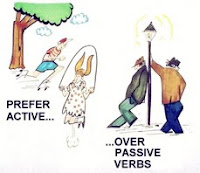
Verbs are also said to be either active (The executive committee approved the new policy) or passive (The new policy was approved by the executive committee) in voice. In the active voice, the subject and verb relationship is straightforward: the subject is a be-er or a do-er and the verb moves the sentence along. In the passive voice, the subject of the sentence is neither a do-er or a be-er, but is acted upon by some other agent or by something unnamed (The new policy was approved). Computerized grammar checkers can pick out a passive voice construction from miles away and ask you to revise it to a more active construction. There is nothing inherently wrong with the passive voice, but if you can say the same thing in the active mode, do so (see exceptions below). Your text will have more pizzazz as a result, since passive verb constructions tend to lie about in their pajamas and avoid actual work. 

Passive and Active VoicesWe find an overabundance of the passive voice in sentences created by self-protective business interests, magniloquent educators, and bombastic military writers (who must get weary of this accusation), who use the passive voice to avoid responsibility for actions taken. Thus "Cigarette ads were designed to appeal especially to children" places the burden on the ads — as opposed to "We designed the cigarette ads to appeal especially to children," in which "we" accepts responsibility. At a White House press briefing we might hear that "The President was advised that certain members of Congress were being audited" rather than "The Head of the Internal Revenue service advised the President that her agency was auditing certain members of Congress" because the passive construction avoids responsibility for advising and for auditing. One further caution about the passive voice: we should not mix active and passive constructions in the same sentence: "The executive committee approved the new policy, and the calendar for next year's meetings was revised" should be recast as "The executive committee approved the new policy and revised the calendar for next year's meeting."
Take the quiz (below) as an exercise in recognizing and changing passive verbs.
The passive voice does exist for a reason, however, and its presence is not always to be despised. The passive is particularly useful (even recommended) in two situations:
  • When it is more important to draw our attention to the person or thing acted upon: The unidentified victim was apparently struck during the early morning hours.
  • When the actor in the situation is not important: The aurora borealis can be observed in the early morning hours.
Passive and Active Voices
The passive voice is especially helpful (and even regarded as mandatory) in scientific or technical writing or lab reports, where the actor is not really important but the process or principle being described is of ultimate importance. Instead of writing "I poured 20 cc of acid into the beaker," we would write "Twenty cc of acid is/was poured into the beaker." The passive voice is also useful when describing, say, a mechanical process in which the details of process are much more important than anyone's taking responsibility for the action: "The first coat of primer paint is applied immediately after the acid rinse."
We use the passive voice to good effect in a paragraph in which we wish to shift emphasis from what was the object in a first sentence to what becomes the subject in subsequent sentences.
The executive committee approved an entirely new policy for dealing with academic suspension and withdrawal. The policy had been written by a subcommittee on student behavior. If students withdraw from course work before suspension can take effect, the policy states, a mark of "IW" . . . .
The paragraph is clearly about this new policy so it is appropriate that policy move from being the object in the first sentence to being the subject of the second sentence. The passive voice allows for this transition.†

Passive Verb Formation

The passive forms of a verb are created by combining a form of the "to be verb" with the past participle of the main verb. Other helping verbs are also sometimes present: "The measure could have been killed in committee." The passive can be used, also, in various tenses. Let's take a look at the passive forms of "design."
TenseSubjectAuxiliaryPast
Participle
SingularPlural
Present The car/cars is are designed.
Present perfectThe car/cars has been have been designed.
Past The car/cars was were designed.
Past perfect The car/cars had been had been designed.
Future The car/cars will be will be designed.
Future perfect The car/cars will have been will have been designed.
Present progressive The car/cars is being are being designed.
Past progressive The car/cars was being were being designed.
A sentence cast in the passive voice will not always include an agent of the action. For instance if a gorilla crushes a tin can, we could say "The tin can was crushed by the gorilla." But a perfectly good sentence would leave out the gorilla: "The tin can was crushed." Also, when an active sentence with an indirect object is recast in the passive, the indirect object can take on the role of subject in the passive sentence:

ActiveProfessor Villa gave Jorge an A.
PassiveAn A was given to Jorge by Professor Villa.
PassiveJorge was given an A.
Only transitive verbs (those that take objects) can be transformed into passive constructions. Furthermore, active sentences containing certain verbs cannot be transformed into passive structures. To have is the most important of these verbs. We can say "He has a new car," but we cannot say "A new car is had by him." We can say "Josefina lacked finesse," but we cannot say "Finesse was lacked." Here is a brief list of such verbs*:
resemble look like equal agree with
mean contain hold comprise
lack suit fit become

Verbals in Passive Structures

Verbals or verb forms can also take on features of the passive voice. An infinitive phrase in the passive voice, for instance, can perform various functions within a sentence (just like the active forms of the infinitive).
  • Subject: To be elected by my peers is a great honor.
  • Object: That child really likes to be read to by her mother.
  • Modifier: Grasso was the first woman to be elected governor in her own right.
The same is true of passive gerunds.
  • Subject: Being elected by my peers was a great thrill.
  • Object: I really don't like being lectured to by my boss.
  • Object of preposition: I am so tired of being lectured to by my boss.
With passive participles, part of the passive construction is often omitted, the result being a simple modifying participial phrase.
  • [Having been] designed for off-road performance, the Pathseeker does not always behave well on paved highways.
Active And Passive Voice: (the passive auxiliaries BE and GET)
Voice distinguishes an active verb phrase from a passive one. It makes possible to view the action of a sentence in two ways. The active passive relation involves two grammatical levels: the verb phrase and the clause.
The active-passive correspondence: Changing from active to passive involves rearangement of two clause elements: The active subject becomes the passive agent, and the active object becomes the passive subject. And the preposition BY can be introduced before the agent. John (active subj.) admired(active verb) Mary. Mary(passive subject) was admired(passive verb) by John(by phrase agent).

The passive auxiliaries BE and GET: The passive auxiliary is normaly BE. We may use GET but it normaly used in case in consructions without animate agent: The cat got run over by a bus. or James got beaten last night. But using it with animate agent is also possible: James got beaten by a gang.
This GET passive is avoided in formal style. The house is getting rebuilt. Sounds unfamiliar.
Even though we use GET in cases of copular sentences, ( I have to get dressed before 8 o’clock)

But these sentences mustn’t be confused with passive sentences. These we also call PSEUDO- PASSIVES. GET puts the emphasis on the subject rather than the agent in both cases (copu. and passive). Get passive often reflects an unfavourable attitude towards the action: How did that window get opened.

Voice constraints: Where the active and passive sentences are not in systematic correspondence:
Five kinds of voice constraint: verb, object, agent, meaning, frequency of use.

Verb constraints: a/ active only: copular and intransitive verbs and the so called “middle verbs do not occur in some senses in passive: have, lack, The auditorium holds 5000 people, The dress becomes her, resemble, suit. But stative verbs of attitude can occur in the passive: He is wanted by the police.

In some cases only the passive is possible: John was said to be good teatcher. They said him to be a good teatcher (difference) . 

Prepositional verbs. In passive they are normally verbal idioms. The enginneers went very carefully into the problem. becomes: The problem was carefully gone into by the engineers. (no sense with tunnel).

Object constraints: Transitive verbs can be followed by clausal or phrasal object. With clauses as objects the passive is restricted in use: Noun phrase as obj.: John loved Mary, Mary was loved by John. Clause as object: Finite clause: John thought that she was attractive. we dont say: That she was attractive was thought by Tom. In Nonfinite clause: infinite: John hoped to meet her. we dont say: To meet her was hoped by John. John enjoyed seeing her. we dont say Seeing her was enjoyed by Tom.


Constraints occur in case of reflexive, reciprocal and possessive pronouns. himself could be seen, each other could be seen, my hand was shaken by the man -> these are all wrong. And passive is not used for idioms in which the verb and the object form a close unit. The ship set sail and not Sail was set.

Agent constraints: In most cases the agent is missing when it is irrelevant or missing. The Prime Minister has often been criticized recently. or where the agent is left out as redundant. Jack fought Michael last night and Jack was beaten. So from the passive we cant conclude to the agent of the active in most cases.

Meaning constraints: The meaning may differ in act and pass. John cannot do it. where it expresses ability, and It cannot be done by John, where it expresses possibility. or Every schoolboy knows one joke at least, which means Every schoolboy knows at least some joke or other. and One joke at least is known by every schoolboy, which means that there is one particular joke that is known to every schoolboy. Difference in meaning has also been noted where both subject and object of the active sentence are generic: Beavers build dams and Dams are built by beavers. (universal interpretation in the first case which doesn’t work in the second case).
Frequency constraints: Stylistic factor determines frequency to a great extent. (impersonal vs. personal style).

The passive gradient: The grade of how strong the passive is.
Central passive or true passive: The violin vas made by my father . and The conclusion is hardly justified by the results. These sentences have a direct active-passive relation, but the first has a personal, the second has a nonpersonal agent.


Semi passives: Both verbal and adjectival properties. a) coordinating the participle with an adjective.
b) modifying with quite rather more c)replacing BE by a lexical copular verb such as feel or seem

We feel rather encouraged and content…. Leonard seemed very interested in and keen on linguistics.

In such adjectival uses of the past participle, it is rare to have a by phrase expressing the agent, but sometimes they occur: I feel rather let down by his indiference. Prepositions however can introduce agent-like phrases. (about,at,over,to,with) We were all worried about the complication=The complication worried us all. 

Pseudo passives: these have no active form and no possibility of agent addition: The building is already demolished. Their verb+ed participle recommends as passives. In terms of meaning they of course have an active equivalent. In 1972 the democrats were defeated. Has dynamic and stative meaning. They occur with current(be,feel,look) and resulting(get,become,grow) copular verbs.
 
Copyright © 2007- Érettségi vizsga tételek gyűjteménye. Designed by OddThemes | Distributed By Gooyaabi Templates